

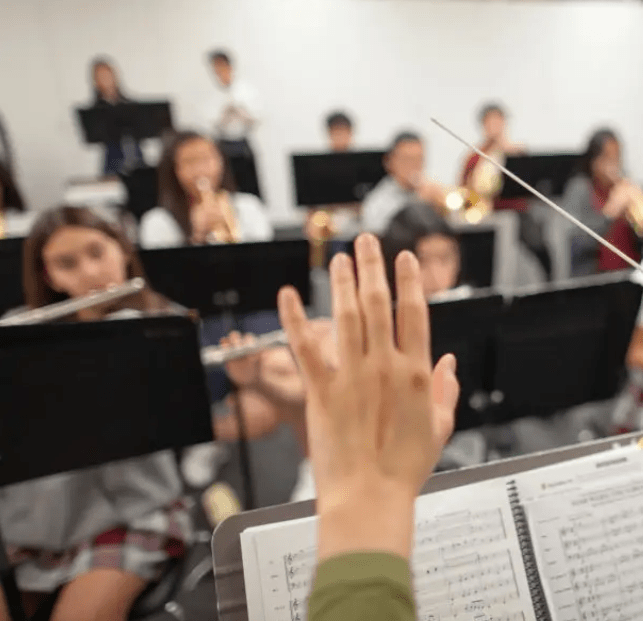
The number of students taking GCSE Music has decreased by 27% since 2014.
In short, pupils in Northern Ireland are increasingly not taking GCSE Music because of reduced interest in arts subjects. Why? Usually due to pressure to attain higher grades in what is considered to be largely “more academic” subjects. As a result, an ever-increasing growth of society’s perception of “more important” subjects devalue appreciation of the work, skill and development of the arts and subjects like music (of course resulting financially with reduced funding). This knock-on effect reflects not only in Northern Ireland, but in Ireland and the UK also and is sadly affecting arts jobs and funding as a result. For example, the Northern Ballet now have to rely on backing tracks for live performances because of lack of financial support to even provide the essential orchestra, which in essence, contributes a great deal of the audience’s experience to the show!
If you Google search ‘Northern Ireland Music Funding’- News, today (25/01/2025) you will discover the most recent article about musical instrument funding in which Roisin McDonough, (Chief Executive of the Arts Council of Northern Ireland), stated: “Northern Ireland has a fine history of musicianship, one which is celebrated all over the world.”
But is ‘Northern Ireland’s music being celebrated all over the world,’ really reflected in our schools, education centres, universities and community centres today?!
Increasing attention to STEM subjects is not necessarily a negative thing. I am all for opening our awareness to under-appreciated education and doing something about it. (For example, I wish more girls in my generation were encouraged to stick with technology at secondary school level).
However, there is a down-side to prioritising solely STEM subjects. When most money, school excursions, equipment and school open nights focus around these areas, we can surely see that a cobweb-clad, outdated, faded, cold music room in the basement/lower corner of the school is not perceived as valuable. (If I see it, certainly students, parents and staff do!) Here again, contributing to this culture of ‘less useful subject- music.’
Where are the much-needed microphones, instruments and recording equipment for the music department when the technology lab is being fitted with new shiny machinery and the chemistry classrooms have been extended AGAIN? Two examples, only. Can I also mention, parents obliged to purchase their children recorder books for class use yet the mathematics department supplies protractors and calculators free for class use? (Okay, three examples!)
I think it is fair to say, ‘if the workspace is depressing, the job probably is too!’ Can we apply that to teenagers’ perceptions when they open their music classroom door and quickly decide ‘nah, not for me,’ due to an outdated area which has been devalued as a potential stepping stone in a career path?
Please note, I am not bashing any school here. This is merely my collection of observations (including my own school experiences) as well as multiple visits to schools and education centres around the whole province.
Regarding curricular expectations, my experiences as a school teacher when being inspected in schools were that the inspectors never cared (or perhaps had time) for music. They wanted to observe me teach mathematics, guide reading groups and demonstrate science lessons over the years across the country. (Never once did I get a comment or smile from inspectors for leading young string groups, djembe drum circles or training choirs. If there is no care at all at an inspection level, is it any wonder principals and staff focus their attention on other curricular areas? Is it any wonder so do time, money, parents, pupils and the school community?
At secondary level education, pupils will decide their career paths. Yet productions today are having to resort to backing tracks. If we do not value it enough, we collectively, in our apathy contribute to a generation ‘not interested’ in making music.

 SM Music Tuition